Most of your waking life goes to work. Whether it builds you or extracts from you is not fixed.
Christina Maslach, the Berkeley psychologist who developed the standard burnout inventory in the 1980s, spent decades watching burnout be treated as a personal failure of resilience. The research said otherwise. Burnout is a response to the structure of a job, the mismatch between what the work demands and what it gives back. You cannot meditate your way out of the wrong job.
Most adults spend the majority of their waking lives working. The quality of that time is one of the largest single inputs into long-term well-being. Decades of research on meaning, flow, autonomy, and calling orientation point the same way: people who find their work meaningful live longer, report better health, and recover from setbacks faster than people who don't. Daniel Pink's synthesis of self-determination theory names autonomy as one of three core drivers, alongside mastery and purpose. The effects are measurable and large.
The newer organizational research adds the structural piece. Frederic Laloux's "Reinventing Organizations" (2014) profiles companies that generate rather than extract: Buurtzorg in the Netherlands, Morning Star in California's tomato belt, Patagonia. Adam Grant's "Give and Take" found that contributors with reasonable boundaries outperform exploiters over long careers, counter-intuitively but consistently. Csikszentmihalyi's flow describes the productive zone where challenge meets skill. How a job is built matters. How a person inhabits it matters. Neither alone is the whole story.
The cultural conversation has gotten stuck between two half-truths. One pole treats work as the site of identity, productivity hacks, hustle as virtue. The other treats work as pure extraction, the thing you survive so you can live the real life elsewhere. Some work drains a person. Other work, done well, gives something back: skill, relationship, the felt sense that you mattered to someone. Both happen.
Two things are true at once. Some jobs are wrong-shaped enough that no amount of reframing fixes them; the structure breaks the worker. Other jobs are workable. The texture of how the worker relates to them shapes whether the work makes them or takes from them. Burnout is a real diagnosis with structural causes. Job crafting, calling orientation, and the choice to bring service rather than extraction to the work are also real. They shape outcomes inside whatever structure a person has. The work is figuring out which kind of job you have, and what each kind asks of you.
Burnout and misalignment are real and treatable. Purpose, flow, and contribution are also real and worth pursuing. They show up in more than one shape. For some, it's Newport's career capital: the slow accumulation of rare and valuable skill, with options as the long-term payoff. For others, it's the realization of skill in the present act (the musician mid-set, the cook at the line, the teacher in the lesson); meaning that lives in the doing, not the stacking. For many, it's what the work makes possible for someone else: a household kept fed, kids put through school. Each is a complete answer.
Concepts
Meaning in work
The sense that what you do matters to someone, contributes to something larger, or is recognizably your own. Amy Wrzesniewski's research shows meaning is less about the job title than how the person frames and performs the work ("job crafting"), which means it's partly modifiable from where you are.
Flow and realization
The state of absorbed engagement where challenge and skill are balanced. Csikszentmihalyi identified the conditions (clear goals, immediate feedback, appropriate difficulty) that produce it. One of the most reliably studied correlates of satisfaction at work, and a practical design target for how you structure your days. Underneath the state sits an orientation worth naming: meaning that lives in the realization of skill in the present act, not in its long-term accumulation. The musician mid-set, the cook at the line, the teacher in the lesson. Flow describes the state; realization is the meaning category.
Autonomy, mastery, purpose
Daniel Pink's synthesis of self-determination theory: the three conditions most strongly correlated with engagement and satisfaction. Autonomy over how you work, progression toward real mastery, and connection to a purpose beyond the paycheck. Jobs that deliver some measure of all three age much better than jobs that trade them for salary.
Burnout
A specific clinical syndrome (emotional exhaustion, depersonalization, reduced efficacy), not just "tiredness." Christina Maslach defined it; WHO now recognizes it. The cause is almost always structural (overload, unfairness, values mismatch, breakdown of community), which means rest alone rarely fixes it.
Calling orientation
Research-backed distinction between seeing work as a job, a career, or a calling. Calling orientation correlates with higher well-being, resilience, and life satisfaction, and it's partly how you relate to your work, not only what the work is.
Service and contribution
Meaningful work is rarely about yourself alone. Adam Grant and the positive-organizational-scholarship literature consistently find that pro-social purpose is one of the strongest predictors of engagement, long-term satisfaction, and resilience against burnout. Available in almost every role. The same logic extends one step further: for many people, the work itself is the means and the people it supports (a household kept fed, kids through school, a parent who can see a doctor) are the meaning. Provision is its own honest orientation, often historically dominant, and underweighted in the wellness conversation.
Extractive vs. generative work environments
Some environments deplete the worker faster than recovery restores them; others return something (skill, relationship, meaning, money, health) for the effort put in. Frederic Laloux's paradigm work ("Reinventing Organizations") maps this at the organizational-structure level and documents real "Teal" organizations (Buurtzorg, Morning Star, Patagonia) operating at scale on self-management, wholeness, and evolutionary purpose. The difference compounds over decades. Worth diagnosing your own environment honestly.
Career capital
Cal Newport's reframe of "follow your passion." Skill, reputation, and options compound; meaning tends to follow craft, not precede it. Early-career work on rare and valuable skills usually pays back more than early-career searches for the "right" calling.
Practices
Practice
A clear end-of-workday ritual
Boundaries · nervous-system shift
A walk, a shutdown routine, a switch of clothes, anything that reliably tells your nervous system the workday has ended. Pick a simple physical action; repeat for two weeks.
Practice
Name your three upstream hours
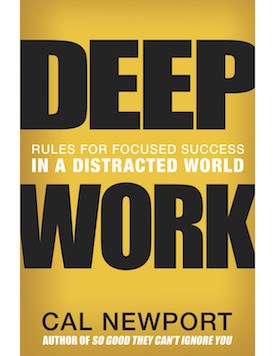
Newport · Deep Work
The hours of your week when judgment, creativity, and attention are at their best. Protect them from meetings and interruption. Look at last week, identify the block where your best thinking happened, defend it this week.
Practice
Name what you are actually paid to do, in one sentence
Role clarity · minimum viable contribution
Clarity about the smallest version of your role that an employer would still pay for. Write it. Edit it. Show it to someone who knows your job. Most people overshoot in their own minds and under-deliver in practice.
Practice
A weekly purpose check-in
Pride and regret review
Ten minutes, once a week. Two honest questions: What did I do this week that I'd be proud to tell someone about? What did I do that I wouldn't? Put it on the calendar for Friday afternoon.
Practice
One hour per week of skill development
Newport · craftsmanship over passion
Not rushed, not performative. A book chapter, a problem, a practice session in the craft of your work. Schedule it; treat it as non-negotiable. The Cal Newport case is that skill compounds where attention is given, not where passion is felt.
Practice
Ask once a month: who am I actually helping with this?
Pro-social purpose · engagement research
Pro-social purpose is one of the strongest predictors of engagement and resilience at work. The question can be asked inside nearly any role, and usually produces either satisfying clarity or honest discomfort worth sitting with. Once a month, when the work feels heavy, ask the question before you check email.
The clinical construct of burnout: emotional exhaustion, depersonalization, reduced personal efficacy. The Maslach Burnout Inventory is the instrument most used in research.
People approach the same work with three distinct orientations, and the 'calling' orientation correlates with measurable well-being differences.
2014
Laloux, F.
Reinventing Organizations (Nelson Parker, 2014)
Maps organizational stages culminating in "Teal" self-managing organizations built on self-management, wholeness, and evolutionary purpose, with twelve real cases (Buurtzorg, Morning Star, Patagonia) operating at scale.
Organizational-psychology research showing that "givers," paired with reasonable self-protection, outperform "takers" and "matchers" over long careers. Contribution is one of the strongest career strategies, not just the ethical one.
1990
Csikszentmihalyi, M.
Flow (Harper & Row, 1990)
Foundational research on the state of optimal engagement: balanced challenge, immediate feedback, clear goals, absorbed attention.
Foundational essay on leadership as service: the best leaders start by wanting to serve first, with leading as a consequence rather than a goal.
Study
Deci, E. and Ryan, R.
U. Rochester, Self-determination theory
The most-replicated framework in motivation research. Autonomy, competence, and relatedness as the three psychological needs that underwrite sustainable engagement.