Looking Up, Looking In
The Artemis II crew came back, changed like every astronaut before them. They saw something larger than themselves. So can you, in quieter ways.
Listen to podcast style conversation(20 min)
Audio generated with Google NotebookLM.
Late at night, indoors, scrolling. Somewhere in the scroll, a still from the Artemis II crew preparing for the first crewed lunar flight since 1972. The thumb stops.
The Artemis II crew came back from their April 2026 flyby with thousands of photographs and the same observation Frank White heard from astronauts forty years ago: borders disappear, the small disputes feel ridiculous, a protective tenderness toward the planet emerges and does not leave. It happens reliably enough that it has a name.
What follows is about that shift, and what it asks of us once it lands. The astronauts saw something. So do most of us, in quieter ways, when the frame opens. The question is what to do with it.
“Most of us live inside a frame too small for the life we are actually living.”
The photograph that changed everything
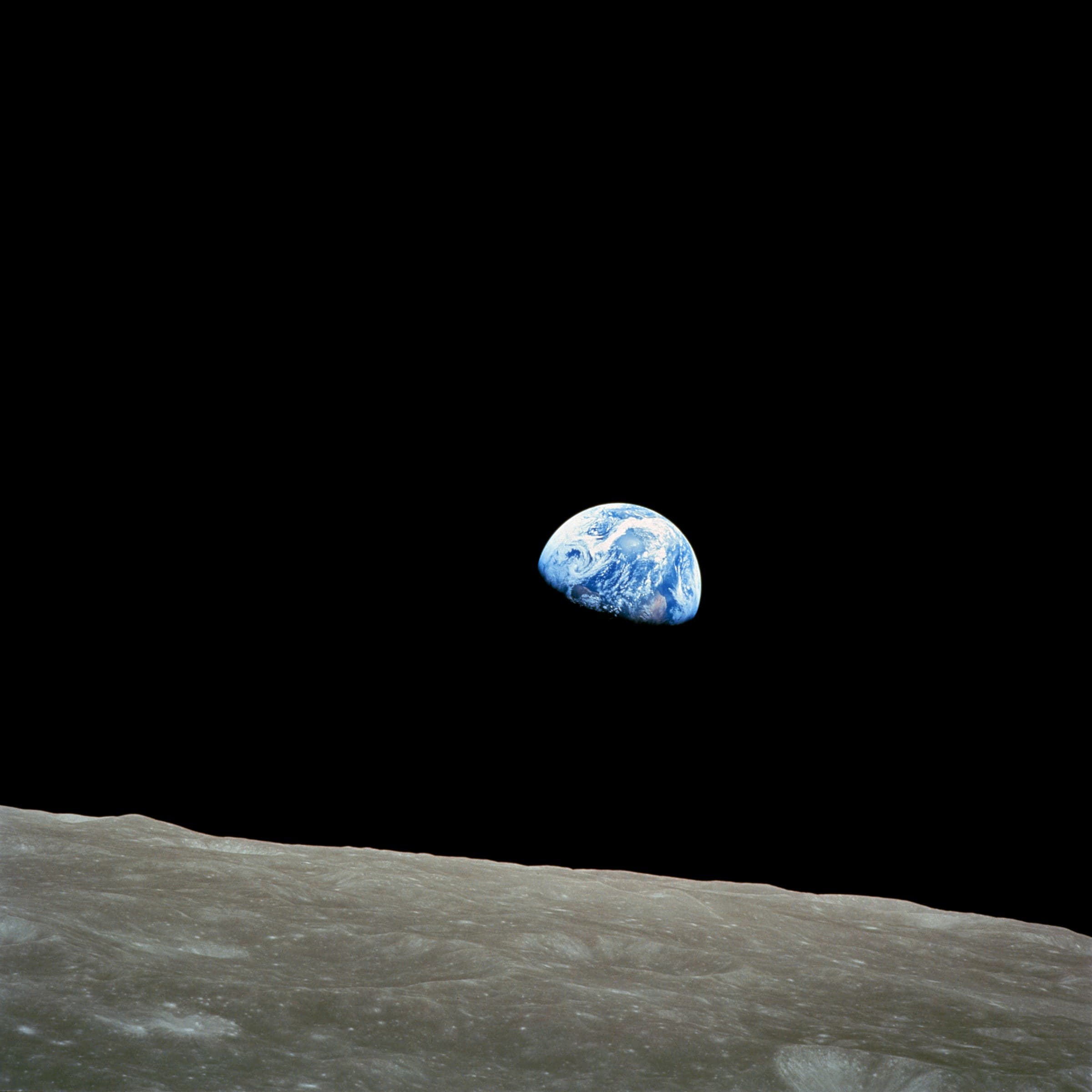
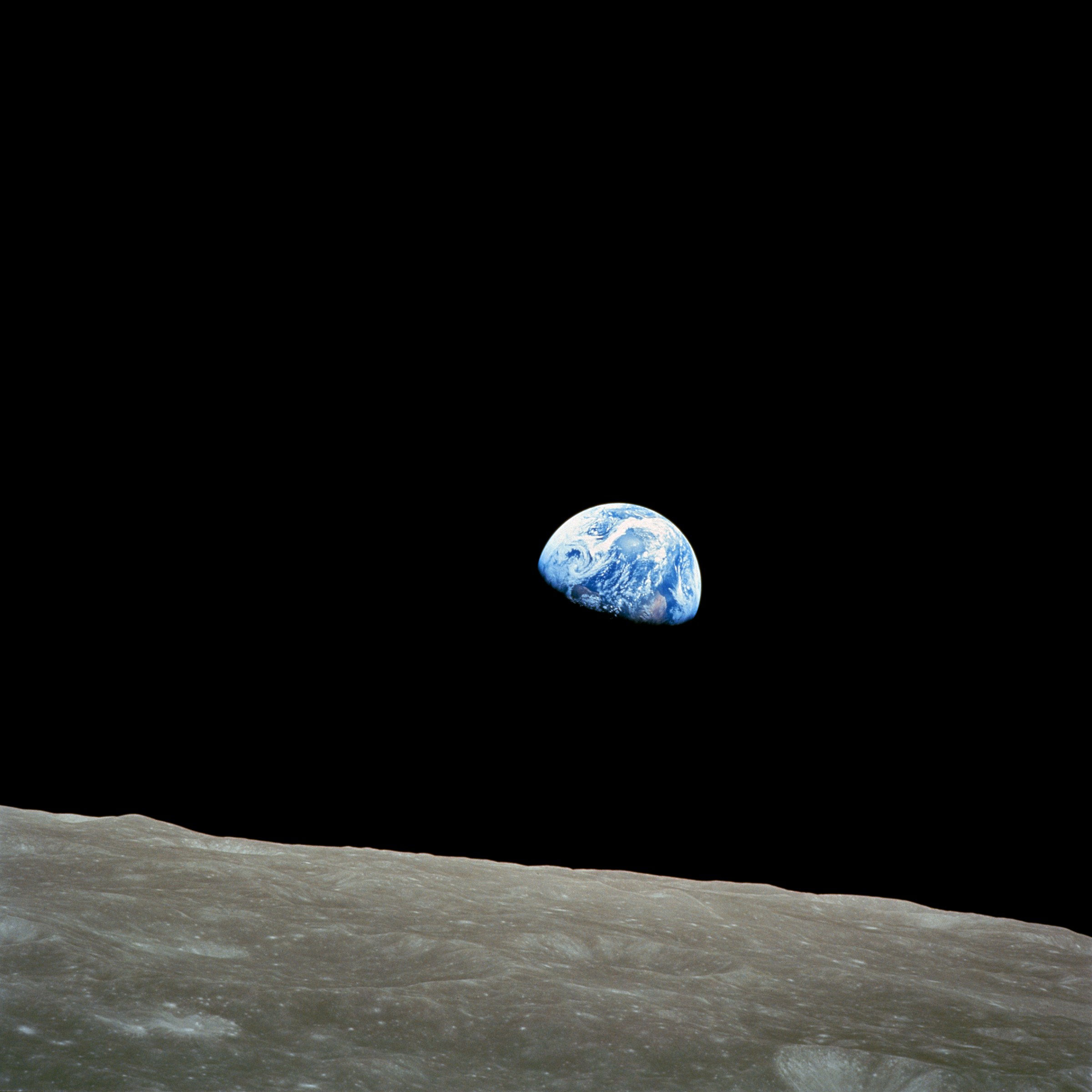
December 24, 1968. Bill Anders, on Apollo 8, looking out a porthole as the spacecraft swung around the far side of the Moon, picks up a Hasselblad and takes a photo. The first image of Earth from another body. Anders said later, in a line that has been quoted in every textbook since: We came all this way to explore the Moon, and the most important thing is that we discovered the Earth.
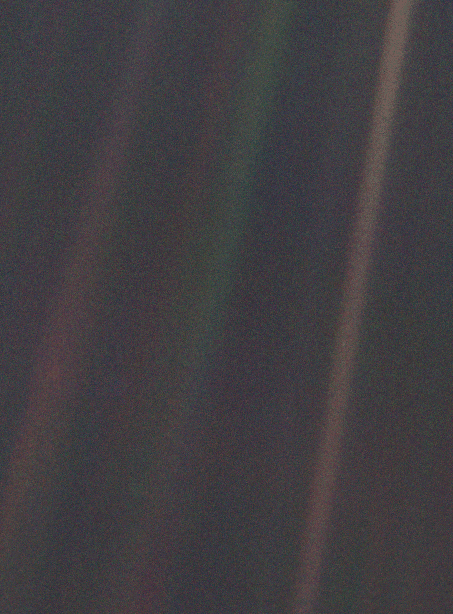
Then, twenty-two years later: Pale Blue Dot. Voyager 1, six billion kilometers from home, turns its camera back at NASA's request. Earth shows up as a single blue-white speck taking up less than one pixel of the frame. Carl Sagan's reflection on what the photograph showed is the most-quoted secular spiritual text of modern science. Look again at that dot. That's here. That's home. That's us.
These images did real work. Modern environmentalism, planetary-health science, the ecosystem-services literature all trace back partly to the moment a generation saw the Earth as a single small body floating in vast dark, and could no longer pretend the planet was an inexhaustible backdrop. The frame had been opened.
The Overview Effect
In 1987, the space writer Frank White interviewed dozens of astronauts and named the consistent psychological shift they reported after seeing Earth from space. He called it the Overview Effect. It is reliable enough across cultures and missions that it functions as research, not anecdote.
Edgar Mitchell, the sixth man to walk on the Moon, described looking at Earth from cislunar space as a samadhi experience, the kind contemplatives in Hindu and Buddhist traditions spend decades training for, arriving in five seconds. Rusty Schweickart, on Apollo 9: “When you go around the Earth in an hour and a half, you begin to recognize that your identity is with that whole thing.”
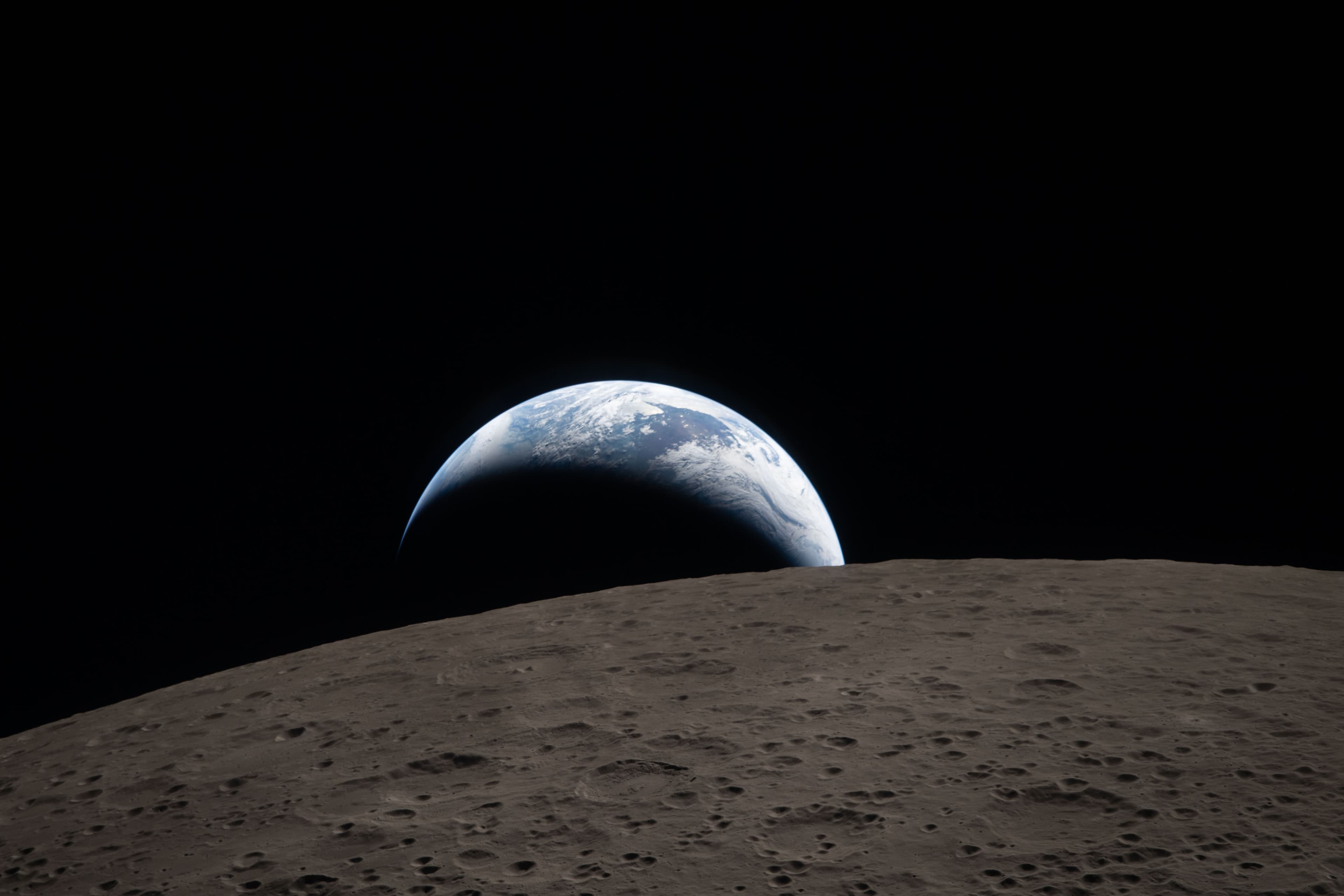
The Artemis II crew (Reid Wiseman, Victor Glover, Christina Koch, and the Canadian Space Agency's Jeremy Hansen) were studied with this in mind. They set the record for the farthest distance any human has traveled from Earth, surpassing Apollo 13 by about 4,000 miles, and during the flyby they captured a crescent Earth setting on the Moon's limb, with the Ohm crater in the foreground. A modern echo of the 1968 Earthrise.
What we now know: the perspective shift is not a one-time high. It rewires how a person relates to scale, time, and other humans, often for the rest of their life. You do not have to go to space to get a sliver of it. The night sky away from city lights does some of the work. So does a long look at a tide pool. So does any moment when the frame opens.
The frame we live inside
Most of our attention goes elsewhere. Work, the news cycle, the rotating crises in geopolitics, the four-inch window of the phone. These are real and demanding. They are not the problem; they are what life inside a modern frame looks like.
What they crowd out is the larger miracle. The night sky, the seasons, the long human journey, the cosmos that holds us. Light pollution hides the Milky Way from roughly 80 percent of North Americans (Falchi and colleagues, Science Advances, 2016). A person who has not seen the Milky Way is missing a piece of the human experience that every previous generation had as default.
This is not a moral failure. It is a system that runs on attention, and the attention being captured was not designed to be captured at this scale. The cost shows up later as a kind of dull meaninglessness, the kind no app or productivity routine can fix. The Overview Effect is one antidote. It is not the only one.
A quick run through the journey
Compressed:
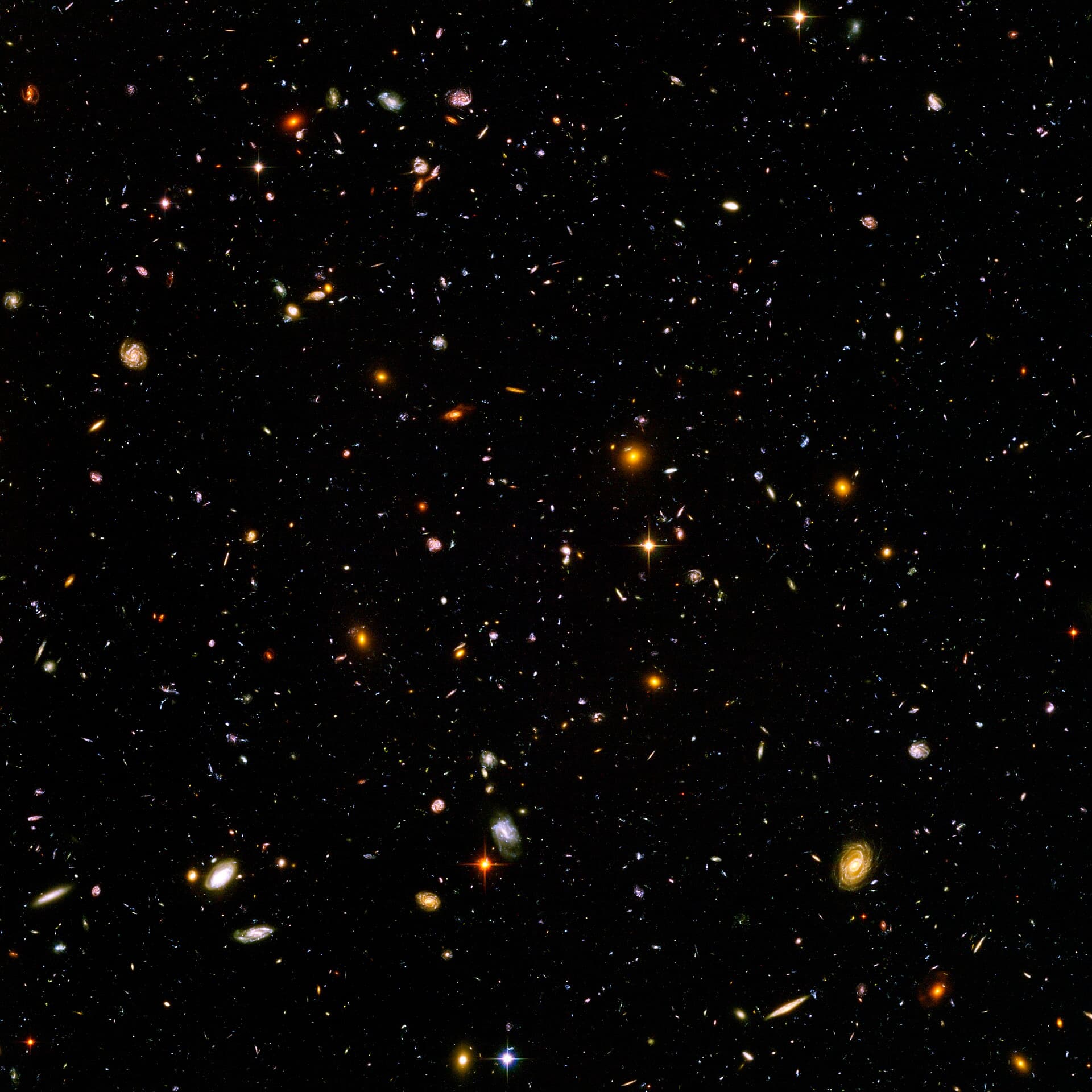
The universe is roughly 13.8 billion years old. The Earth, 4.5 billion. Single-celled life, 3.5 billion. Multicellular life, 600 million. Mammals, 200 million. Our genus Homo, about 2 million. Anatomically modern humans, around 300,000. Recorded history begins maybe 5,000 years ago.
You arrived in a window of cosmic time so narrow that, to a first approximation, you are a contemporary of every human who has ever lived. The two-thousand-year gap between you and the person reading by oil lamp is, on the cosmic clock, the same instant.
You are made of atoms forged in stars that exploded before our solar system existed. The carbon in your hands was once stellar fuel. The water in your blood is older than the planet. None of this is metaphor. Whatever else this is, it is a miracle in the precise sense of the word: an event vanishingly unlikely, occurring anyway. You got a turn at it.
From awe to gratitude
Dacher Keltner studies awe, the emotion that arises when a person encounters something vast and incomprehensible enough to require accommodation in their existing understanding of the world. His finding, gathered across cultures: awe reduces self-focus, strengthens prosocial behavior, and is reliably linked with well-being. His 2023 book, Awe: The New Science of Everyday Wonder, is the best general account.
Awe is the bridge. The cosmic frame opens. The ego quiets. Something Robin Wall Kimmerer has named for years gets through: all flourishing is mutual. The wild strawberry, in her telling, is a gift; you receive it; you owe something back. Gratitude is not politeness. It is the correct relationship with a world that kept you alive.
This is not religious in the narrow sense. The atheist physicist and the practicing Christian and the secular Jew and the lapsed Buddhist can all stand under the same night sky and feel the same thing. The vocabulary differs. The gravity is shared.
Then: what now?
Once the frame opens, once the awe lands, once the gratitude follows, the question that arrives is not the abstract one. It is more local: what is my participation in this voyage?
Viktor Frankl is the brand's recurring anchor on this question. Man's Search for Meaning: meaning is not a thing you find pre-packaged. It is what you bring to the encounter between you and what life puts in front of you. The prisoners in the camps who endured were the ones who could meet the worst conditions and still find something to hold.
Bill Plotkin's Soulcraft and James Hillman's The Soul's Code circle the same idea from different vocabularies. Each person carries a particular gift, an acorn, a calling that is theirs to bring forth. The work is to recognize it and do it. These are not contradictory traditions. They name the same human territory in different languages.
“The participation is the point.”
The lifelong unfolding
Soul work is slow. The Greeks distinguished bios (the biography, the particular life you live) from zoe (the larger flow of life that runs through all living things). Soul work happens at the bios level: the slow individuation of who you specifically are.
It is not a project with a deadline. The person you are at thirty is not the person you are at sixty. The calling shifts. The gift refines. The question (what am I here to do, and to be?) gets asked again, with new information, every decade.
This connects up for some readers and out for others. Some hold it inside a religious tradition, and the higher power is named. Some hold it inside a humanistic frame, and the largeness is the universe itself. Both are real entries into the same territory. Soul Syndicate covers both seriously and pretends to neither. What we do not say: that the unfolding ever finishes. It does not. The participation is the point.
The Tuesday version
Small moves a reader can make this week.
- Stand under the night sky. Drive thirty minutes from city lights. Look up for twenty minutes without a phone. Note what changes.
- Read the Pale Blue Dot reflection aloud. Three minutes. It does what it does.
- Write down five things that had to go right for you to be alive in this specific moment. Star formation, plate tectonics, your great-great- grandparents' choices. The list extends as far as you take it.
- Ask the question annually. What is mine to carry, in this stretch of life? Write the answer down and read it next year. Watch how it shifts.
- Find one elder thinker in your tradition (or none). Read them slowly, over a year, not a week. Frankl, Kimmerer, Plotkin, Hillman, Sagan, Chödrön; pick one and stay.
None of this requires belief. It requires attention.
The closing frame
You got a turn. The cosmos is older than you, larger than you, and somehow includes you. The astronauts who saw Earth from outside it came back changed. You can borrow the change without the trip.
The voyage is collective. Each person carries something specific to give, and the larger unfolding is the sum of those gifts being given. All flourishing is mutual. Whatever you call the largeness (God, universe, the long arc, none of the above), your job is the same.
Stand under the sky tonight. Notice you are alive. Ask what you are here for. Do the next small thing.
Earthrise
Emergence Magazine · 30 min · directed by Emmanuel Vaughan-Lee
Wellness research, mental health insights, and the ideas behind the practice, straight to your inbox.
Further reading
- The Overview Effect, Frank White (1987; updated editions through 2021).
- Pale Blue Dot, Carl Sagan (1994). The reflection referenced is in chapter one.
- Awe: The New Science of Everyday Wonder, Dacher Keltner (2023).
- Braiding Sweetgrass, Robin Wall Kimmerer (2013). The gratitude argument runs throughout.
- Man's Search for Meaning, Viktor Frankl (1946).
- Soulcraft, Bill Plotkin (2003) and The Soul's Code, James Hillman (1996), for the calling-and-acorn framing.
- The Artemis II mission page for the photographs and crew accounts referenced above.
For the dimension this work belongs to, the Soul & Spirit hub holds the rest of the practice.
Soul & Spirit Hub →